


MarcusRock
Well-Known Member
- Messages
- 18,260
- Reaction score
- 21,941
There's been misinformation going around about how this new rule will take away goal line dives, diving for first downs, football is a dying sport (that they continue to watch), yadda, yadda, yadda. It's actually pretty simple.
Here is wording from the NFL:
Key words here are "giving himself up." QBs (and other runners for that matter) usually give themselves up to avoid a hit. Some QBs are terrible sliders but it's usually clear that they intended to duck down before being hit. This is what the new rule covers and yes, a player is ruled down where they begin their slide just like the original rule.
"Lunging" for yardage is something different. A player is taking a known risk to get more yardage. The act of lunging is done by a player under control of his body and is thus not a defenseless player but one looking to gut the defense for additional yardage. That's not giving one's self up (abandoning gaining additional yardage to play it safe).
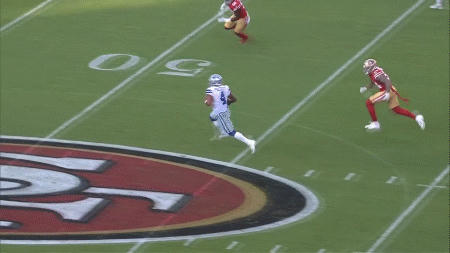
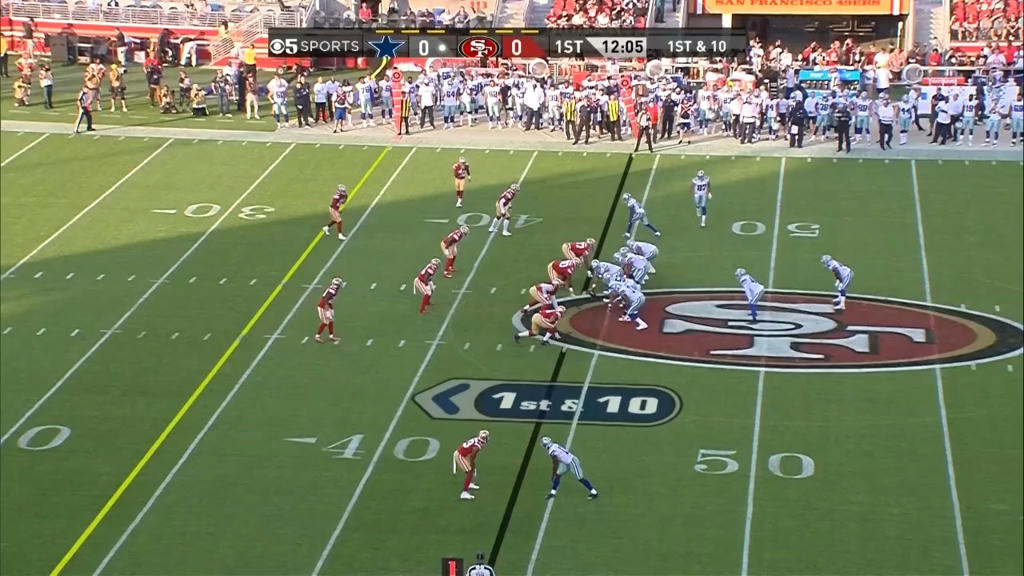
To demonstrate, here is video of Dak taking off and running vs. the 49ers last Thursday. I freezed the video at Dak's takeoff point, slow down his dive, and then freeze again at his landing point (while being contacted) to show that he was awarded all the yardage of his (not very pretty) lunge. The picture underneath shows the line of scrimmage on the next play which was an almost perfect spot by the Line Judge who trailed on the play. If Dak was considered to "give himself up," the spot would clearly be before the 45 yard line where he began his dive, not after. If a runner was considered down at the point he dives, then no RB could dive over the goal line from the 1 like Walter Payton used to. That makes no sense. Thus, the rule is not written that way.
Here is wording from the NFL:
"A quarterback does not have to slide feet first to be considered to be giving himself up. Regardless whether the slide is feet first or head first, as long as he gives himself up, he should receive the protections afforded to him as a player in a defenseless posture."
https://operations.nfl.com/the-rules/2018-rules-changes-and-points-of-emphasis/
https://operations.nfl.com/the-rules/2018-rules-changes-and-points-of-emphasis/
Key words here are "giving himself up." QBs (and other runners for that matter) usually give themselves up to avoid a hit. Some QBs are terrible sliders but it's usually clear that they intended to duck down before being hit. This is what the new rule covers and yes, a player is ruled down where they begin their slide just like the original rule.
"Lunging" for yardage is something different. A player is taking a known risk to get more yardage. The act of lunging is done by a player under control of his body and is thus not a defenseless player but one looking to gut the defense for additional yardage. That's not giving one's self up (abandoning gaining additional yardage to play it safe).
To demonstrate, here is video of Dak taking off and running vs. the 49ers last Thursday. I freezed the video at Dak's takeoff point, slow down his dive, and then freeze again at his landing point (while being contacted) to show that he was awarded all the yardage of his (not very pretty) lunge. The picture underneath shows the line of scrimmage on the next play which was an almost perfect spot by the Line Judge who trailed on the play. If Dak was considered to "give himself up," the spot would clearly be before the 45 yard line where he began his dive, not after. If a runner was considered down at the point he dives, then no RB could dive over the goal line from the 1 like Walter Payton used to. That makes no sense. Thus, the rule is not written that way.


