

dwmyers
Well-Known Member
- Messages
- 2,373
- Reaction score
- 522
The article (and it's important) is here:
http://www.grantland.com/story/_/id/8287610/packaged-plays-rethinking-concept-modern-play-calling
I can't emphasize enough how important it is.
I don't think the article is reducible into just a few words without killing the whole notion that's going on. We'll try some excerpts, maybe we'll steal an image from Grantland, to try and get the point across..
So let me pause and ask a couple questions here: given Andy Reid's close ties to the Green Bay organization, do you think he's ignorant of this kind of offensive trend?
In this day and age, do you think it's going to be easier to hide a linebacker with a weakness to either the run or the pass?
D-
http://www.grantland.com/story/_/id/8287610/packaged-plays-rethinking-concept-modern-play-calling
I can't emphasize enough how important it is.
I don't think the article is reducible into just a few words without killing the whole notion that's going on. We'll try some excerpts, maybe we'll steal an image from Grantland, to try and get the point across..
Using a no-huddle approach, Oklahoma State often called the same, simple play repeatedly as they marched up and down the field, with Weeden as point guard for their dynamic attack. The basis was simple: "It's all runs or throws on the perimeter, all built into one," explained Oklahoma State's offensive coordinator, Todd Monken. "[Against Texas] A&M, we ended up with a lot of throws on the perimeter that were built-in runs, so that [Weeden] gets all the stats, but they're really just part of your run package."
Oklahoma State's favorite "run package" was to combine an inside running play, like the inside zone, with both a quick receiver screen to one side and an individual route to a singled-up Justin Blackmon. It made for a kind of three-on-one fast break adapted to football.
the trend of combining entirely different categories of plays — runs and passes, screens and passes, runs and screens — is new, and these ideas are at the forefront of thinking about football.
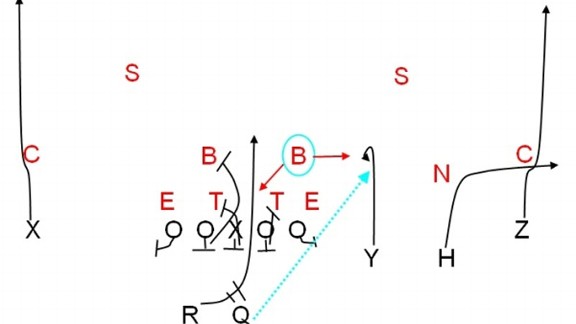
The combination of plays is designed to focus on a key defender. In this case, it's a linebacker, who stands as an unchecked threat to stop the draw and the quick inside pass route. One solution is the one Peyton Manning has made famous — calling an audible before the snap based on where that "key defender" lined up. The problem with that is we only care about what that defender does after the play begins. The better answer is to build the play itself around the key defender, and to read him. Enter the stick-draw.
If the key linebacker flies out for a pass route, the quarterback hands the ball to his running back; if the key linebacker steps up for the run, the QB fires the ball to the receiver for a quick, ball-control pass.
packaged plays have hit the NFL, too. This brings us back to the Packers and Aaron Rodgers. On the play against the Bears that was discussed earlier, what had looked like a simple screen pass was actually a variant of the stick-draw; it was the "stick-screen" — a quick passing play combined with a running back screen.
So let me pause and ask a couple questions here: given Andy Reid's close ties to the Green Bay organization, do you think he's ignorant of this kind of offensive trend?
In this day and age, do you think it's going to be easier to hide a linebacker with a weakness to either the run or the pass?
D-


